Resources
Common Topics & Community Resources
Core Documents
Emergency Preparedness
FAQs
Why should I call 9-1-1? Isn’t it faster to just have someone drive me to the hospital?
Firefighter-EMTs and firefighter-paramedics can begin treating and stabilizing patients even before they get to the hospital, improving outcomes for patients suffering from respiratory problems, heart attacks, diabetic-related incidents, and many other emergencies.
The firefighter-paramedics can also “alert” the hospital so they are prepared for your arrival—this is particularly critical for patients suffering from heart attacks and strokes. The hospitals need time to prepare teams and equipment for the arrival of a patient. Not only is the hospital ready and waiting for the patient when he or she arrives, but the patient has also received important treatment on the way to the hospital—saving critical time.
Why do fire engines come when I call 9-1-1 for a medical emergency?
It’s not the vehicles that are needed – it’s the people. When you call 9-1-1, the closest unit is dispatched to your location. Each East Pierce unit – ambulance or fire engine – has two or three responders. More than 80 percent of all calls need more than two people, so a second closest unit is also dispatched.
Occasionally, a chief officer will also arrive for observation and training purposes. A volunteer unit may also respond, since they may be closer than firefighters at a staffed station.
For certain emergency medical responses, at least four, and sometimes as many as 6-8 firefighter-EMTs and firefighter-paramedics are needed to provide critical treatment and to safely move patients into the Medic unit (fire department ambulances). CPR calls, for example, are very labor-intensive.
When it comes to fires, it takes 15-17 firefighters to safely battle even a relatively small house fire. Frankly, it’s safer for everyone to send more people than we might need and turn them away than have to call for backup because we don’t have enough responders.
Why do I get a bill for ambulance service? I thought there was no cost to residents.
Residents transported by East Pierce Fire & Rescue Medic units incur no “out-of-pocket” expenses.
We bill your insurance company, Medicare or Medicaid for the cost of the ambulance ride. EMS Levy funds are applied to any balance not paid by your insurance.
Residents may receive a statement – not a bill – from our billing service requesting information to submit to the insurance company.
To help support our EMS services, those who live outside of the district are charged for ambulance transports.
Occasionally, a private ambulance will respond to the call if all of our personnel are responding to multiple calls or a large-scale fire. They are a separate corporation and will charge you for the ambulance ride.
Remember, there is never any charge for us to respond to a scene and assess a patient, so “When in Doubt, Check it Out!”
Can I go to the hospital of my choice?
Most of the time, you get to choose the hospital, if it is a reasonable distance away. But if there is an immediate life threat as the result of a car accident or in the case of certain types of medical emergencies, you may need to go to the closest hospital.
Certain patients, such as those with critical injuries or burns, or those suffering from a heart attack or stroke, need to go to a “designated” hospital with specialized staff and equipment to be able to care for them.
Sometimes hospitals are on “diversion”, meaning that the emergency department is full and will only accept new patients under the direst circumstances. The good news is that there are lots of hospitals to choose from in our area.
Why do the 911 dispatchers ask so many questions? Aren't they wasting time?
Even while the dispatcher is talking to you on the phone, other dispatchers are already starting emergency units to the scene.
The dispatchers gather valuable information and then relay this via radio to the firefighters* while enroute to the incident. This information may determine if they need additional units to respond and what equipment to bring into the house.
Dispatchers can provide valuable CPR and first aid instructions over the phone, so don’t hang up until told to do so by the dispatcher.
What’s the difference between a “heart attack” and a “cardiac arrest”?
During a “cardiac arrest”—the heart stops, and the patient becomes unconscious in seconds. Irreversible death will occur within a few minutes unless CPR is started and an AED or defibrillator is used.
During a “heart attack”, one of the heart’s own blood vessels is blocked or narrowed, resulting in a lack of oxygenated blood to a portion of the heart. If the artery is not re-opened with treatment in a specialized hospital to open up the blocked artery, a portion of the heart dies, leaving a victim permanently disabled.
Signs of a heart attack can include: chest pain or discomfort, pain radiating down either or both arms, pain radiating to the neck, jaw or the upper back, shortness of breath, weakness, dizziness and nausea. Signs very widely among patients. For women, signs are often very subtle and include indigestion. Most people wait hours before calling 9-1-1 leading to irreversible heart damage.
Some heart attacks are so significant, that the patient collapses in just minutes into cardiac arrest.
Bottom line—heart attacks can be difficult to recognize. “Time is Muscle!” So call 9-1-1 early!
If I learn CPR and First Aid, can I get sued if I try and help someone who is ill or hurt?
Washington State has excellent Good Samaritan Laws that help protect people from being sued if they try to help others.
If you have good intent and act reasonably, you’re protected even if you make a mistake.
For conscious patients, you should get consent to help (“My name is Joe—I’m trained in first aid—may I help you?”). Victims who are conscious and acting rational, can refuse aid, in this case, move away from the patient, and still call 9-1-1 if you think help is needed.
For unconscious patients, the consent is implied (one assumes that they would want help).
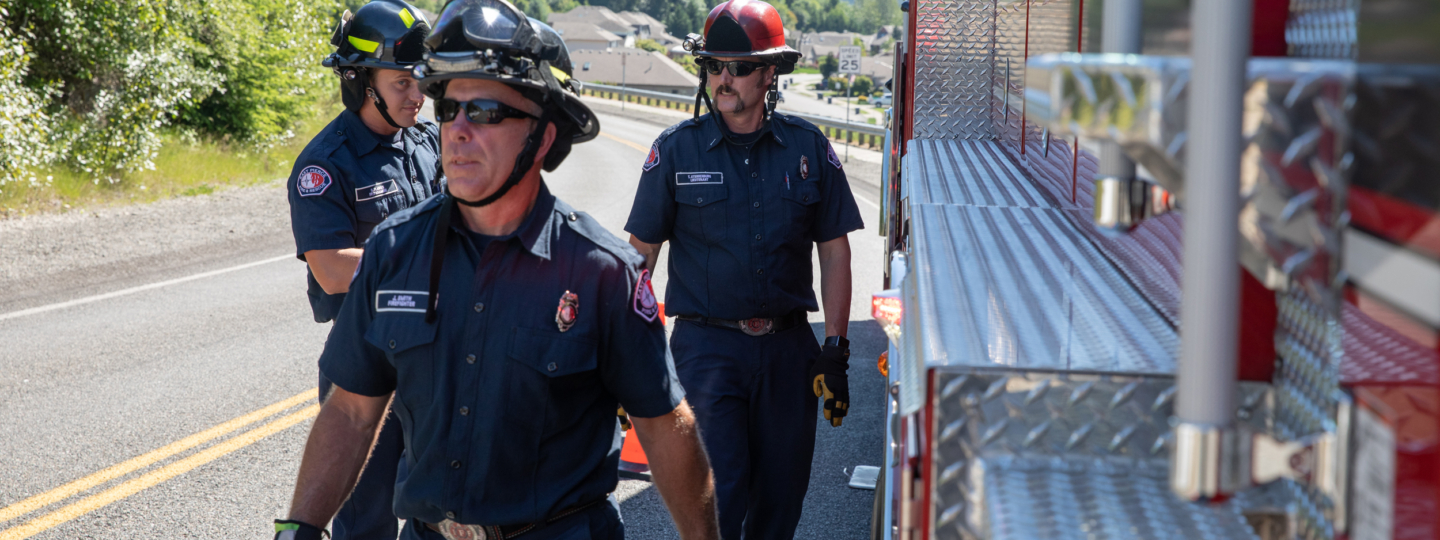
When there is a vehicle crash, why do fire engines and Medic units block traffic?
Working at the scene of car crashes places the firefighters at great risk. Every year, firefighters and paramedics, who are working on injured patients at a accident, are killed and critically injured by people driving their cars or trucks through the incident scene.
Often the people are driving at high speeds, and failed to slow down as they approached the crash scene. Other drivers are drunk, get confused about what’s happening, or are simply impatient to get somewhere.
As a result of on-going firefighter deaths and injuries, our department follows federal and state guidelines to protect these scenes by positioning fire engines and other vehicles to block the scene from incoming cars or trucks. In many cases, this means we will block the lane next to the crash site to provide a safe working zone for our firefighters, law enforcement, and the people we are trying to rescue and treat.
We recognize that our “blocking traffic” can be aggravating when you are in a hurry. For a number of reasons, including patient care, we try to move quickly and safely to get off the scene so traffic interruptions can be minimized. We hope this helps you understand what is taking place at these incidents.